
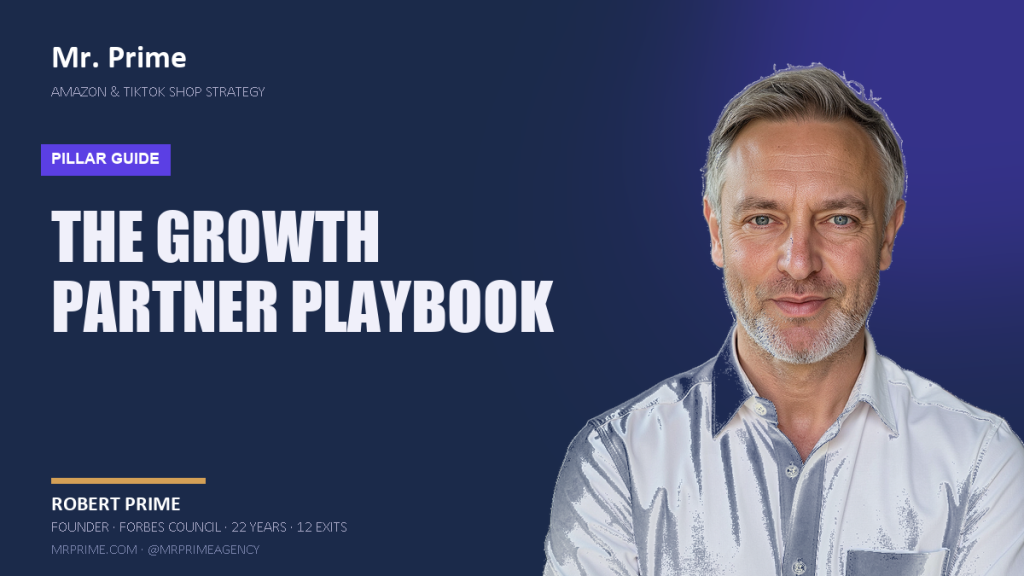

How we build Amazon brands that scale to exit — not just rank for keywords. By Robert Prime, founder.

Why this exists
Most agencies optimise clicks. I engineer balance-sheet value.
That’s not a tagline. It’s what 22 years and 12 successful exits taught me. I’ve walked into due diligence rooms with spreadsheets open and buyers asking about SDE margins, not CTR. I’ve seen brands sell for 6X multiples because the financials were clean and the repeat-purchase curve was beautiful. And I’ve seen brands fail to close because their Amazon account was a mess of PPC burn and one-star review firefighting.
Most brands plateau because they treat Amazon like a marketing channel. Not an asset class. They hire agencies that optimise campaigns, not businesses. The difference compounds over 18 months. One brand exits. The other is still troubleshooting its listing copy.
I started Mr. Prime because I saw that gap everywhere. Brands running hard, spending smart on ads, but structurally unable to scale past a ceiling. The agency wasn’t thinking like an owner.
Three kinds of brand I serve
Manufacturers and B2B with channel conflict fear
You make a product. You sell it through trade partners or B2B channels. You know Amazon is revenue upside, but you’re terrified it’ll cannibalise wholesale or provoke your biggest distributor to walk.
So you do nothing. Or you half-launch and never promote it. The listing sits at page 11. Your competitors eat the search volume.
This is the exact problem I solved for Ultrimax Coatings. Manufacturing brand, channel conflict anxiety, needed Amazon without triggering wholesale anger. We built the Partition Strategy: Amazon-exclusive bundles and SKU configurations that don’t compete with your trade catalogue. Same brand. Different format. No channel collision. Ultrimax saw month-on-month sales growth without one distributor complaint.
Consumer brands stuck in the £500K–£5M plateau
You’ve cracked product-market fit. You’ve got a Shopify store, maybe wholesale in a few independents. You tried Amazon and it works — sort of. You’re doing £60K/month, maybe £120K in December. But you can’t break through.
Generalist agencies can’t move you because they treat every client the same. They run Sponsored Products, tweak bids, refresh the listing once. You plateau because the strategy is generic. It’s a blueprint.
What I do differently: I forensically audit what’s holding you back. For some brands it’s hidden reimbursement bleed (we recovered £61,000 for one client). For others it’s PPC structure — we’ll rebuild campaigns from zero and cut ACoS by 40% without cutting sales. For others it’s external traffic integration or repeat-purchase sequencing through Subscribe & Save.
Proceive is the case study here. We 3X’d their monthly sales in one year. Not through one lever. Through the right combination of levers their business needed.
Sellers / solopreneurs past 7 figures
You’ve built a £3M+ Amazon business on your own or with a small team. You’ve got the hustle. But scaling past this point needs different infrastructure. The systems that got you to £3M will not get you to £10M.
You need professionalised PPC. You need automated reimbursement tracking. You need profitability analysis per SKU that doesn’t live in a spreadsheet you update once a quarter. You need an agency that thinks like a finance director, not a media buyer.
I built Mr. Prime’s ops around this exact stage. We bring top strategists and top tech — no mid-tier in-between. EziDrops is the example: Bob Gokani’s brand had been through two bad agencies before us. We rebuilt everything. The business is now scalable and profitable, not just busy.
The 20,000-Point Forensic Audit
This is the cornerstone of how I work. It’s why I can promise specific outcomes and deliver them. And it’s free — we do it before any engagement, no obligation.
Most agencies do audits by having a strategist look at your account for 90 minutes. They spot 8–12 things and call it thorough. That’s guessing.
We built an automated audit through complex AI. It runs 20,000 checks across your entire Amazon presence. It’s forensic. It’s exhaustive. And it finds the money you’re leaving on the table.
What it covers:
PPC structure and waste. Campaign segmentation, keyword cannibalization, bid inefficiency, negative-keyword gaps. We’ve cut client ACoS by 30–50% just by fixing structure.
Reimbursement bleed. Lost inventory, damaged units, customer returns that Amazon owes you for but never processed. One client: £61,000 recovered. That’s profit you already earned.
Listing optimisation and conversion rate. Title structure, bullet hierarchy, A+ Content design, image compliance. We don’t rewrite copy for SEO theatre — we rewrite it because conversion rate moves revenue.
Operational inefficiencies. FBA fee structure, storage cost by SKU, stranded inventory. For some brands we’ve found 15–20% margin improvement just by fixing logistics.
Brand Registry and IP standing. Counterfeit vulnerability, brand gating issues, trademark weaknesses that let competitors hijack your buy box.
Review depth and velocity. How fast you’re generating reviews relative to your sales volume, whether you’re at risk of review removal, how your sentiment compares to category benchmarks.
Proceive is the outcome proof here. The audit found PPC waste and listing conversion drag. We fixed both. Sales tripled in 12 months. Ultrimax saw the same pattern — month-on-month growth because we found the structural blocks and removed them.
The audit takes 48 hours to run. You get a full report with prioritised actions. And if we’re not the right fit, you walk away with a roadmap worth £15K–£25K of consulting insight. No cost.
The Partition Strategy explained
This is the specific playbook for manufacturers and B2B brands terrified of channel conflict.
Here’s how it works in practice:
1. We create Amazon-exclusive SKU bundles or pack sizes that don’t exist in your wholesale catalogue. Same product, different format. Example: you sell a 500ml bottle through trade. We sell a 3-pack on Amazon.
2. We price it so the per-unit cost is competitive with retail but not undercutting your wholesale partners. The bundle format justifies the structure.
3. We promote it aggressively on Amazon. High ad spend, external traffic, influencer push. You dominate the search terms. Your distributors see no conflict because the SKU isn’t in their catalogue.
4. Your brand grows on Amazon without cannibalising trade. Both channels thrive.
Ultrimax Coatings is the case study. Manufacturing brand, channel conflict fear, needed revenue growth without distributor backlash. We built the partition. Month-on-month sales growth. Zero complaints from trade partners.
This works because Amazon and wholesale serve different buying behaviours. Wholesale is bulk, routine, relationship-driven. Amazon is impulse, convenience, search-led. The Partition Strategy lets you win both without collision.
PPC + AI: how I cut ACoS without cutting sales
Our agency average ACoS is 22%. Some clients run higher, some lower. But almost always we reduce ACoS and maintain or grow sales. This is rare. Most agencies do one or the other — cut spend and kill growth, or grow sales and burn margin.
Why the difference? We treat PPC like a portfolio, not a campaign dashboard.
Every SKU has a different job. Some are acquisition engines — high ACoS, high volume, building the flywheel. Some are profit engines — low ACoS, high margin, funding the business. Most agencies optimise every campaign for the same target. That’s structurally wrong.
We segment by product role. We use AI to adjust bids in real time based on conversion rate, inventory levels, seasonality, competitor behaviour. We build negative-keyword architectures that stop internal cannibalization. We integrate external traffic so Amazon PPC isn’t doing all the acquisition work.
The outcome: lower average ACoS, higher total profit, sustained sales growth.
This isn’t about hacks. It’s about financial discipline and brand infrastructure. Profitable PPC at scale is what funds product development, external marketing, hiring, and ultimately a sellable business. Without it, you are running the same race every month with no compounding leverage.
If your PPC is profitable at scale, you can fund everything else. If it’s not, you’re on a treadmill.
Client retention: Mr. Prime vs UK Amazon-agency industry
Source: Mr. Prime book-wide retention rate (Q1 2026, n=24 active clients) vs Sermondo 2025 UK agency retention benchmark.
The compounding 6–12 month curve
I won’t promise 30-day miracles. I’ve done 12 exits. I know what sustainable scaling looks like. It’s not a hockey stick in month one. It’s a compounding curve over 6–12 months.
Month one: audit complete, strategy finalised, campaigns rebuilding. Month two: early improvements, data gathering, PPC structure optimising. Month three: sales growth starts, profitability stabilises. Month six: the compounding kicks in. Sales are 40–80% higher than baseline. ACoS is lower. Margin is stronger. Month twelve: you’re at 2–3X where you started, and the business is structurally sound.
Indigo is the case study here. Sales more than doubled in 6 months. Profitability increased 25%. Not because we ran one campaign hard. Because we engineered the entire account for compounding growth.
Birchall Tea (Imporient UK) is the longer view. +80% Amazon sales over 2 years. That’s not a sprint. That’s sustainable, scalable, exit-ready growth.
The brands that fail on Amazon are the ones chasing quick wins. They hire an agency, spend aggressively for 8 weeks, see no miracle, then pull the budget. The brands that win commit to 12 months and let the compounding curve do its work.
If you’re not willing to give this 6 months minimum, we’re not the right fit.
Why no two of my growth plans look the same
I mean that literally. Every growth plan I write is custom-built for the brand’s specific constraint. Sometimes the constraint is logistics. Sometimes it’s repeat purchase rate. Sometimes it’s external traffic. Sometimes it’s seasonal timing.
From the exits I learnt every business has a unique need. One was logistics efficiency — we had to fix FBA cost structure before we could scale profitably. One was repeat custom and aggressive ads — high lifetime value justified high acquisition cost. One was external traffic — Amazon PPC alone couldn’t move the needle, so we built influencer and email funnels into the account. One was timing and end-of-year/seasonal spikes — we engineered the entire year’s ad spend around three peak windows.
All very different plans and strategies.
Most agencies have a playbook. They run the same 6-step process for every client. It’s efficient for them. It’s bad for you. Because your business isn’t the same as the last brand they onboarded.
I don’t scale Mr. Prime by templating growth plans. I scale by hiring top strategists and building top tech. Every client gets a bespoke strategy. It takes longer to build. It works better.
What I won’t do
I’m honest about boundaries. There are brands I say no to, and I’d rather be clear now than waste your time.
I don’t take brands under £100K in annual Amazon revenue. Not because they’re not good businesses — they are. But the infrastructure I build is overkill at that stage. You’d be better served by a generalist agency or doing it yourself.
I don’t work commission-only by default. If you’re not willing to invest in growth, you’re not ready to scale. Commission structures work for some brands after we’ve proven results, but not as the starting engagement.
I don’t promise rank #1 in 30 days. That’s not how Amazon works. Rankings are an outcome of conversion rate, sales velocity, review depth, PPC structure, and external traffic. I engineer the system. The ranking follows.
I don’t take brands with weak product-market fit. If your reviews are below 4.0 stars or your product genuinely isn’t competitive, no amount of PPC will fix that. I’ll tell you in the audit if that’s the issue, and I’ll recommend fixing product before spending on growth.
The brands I say no to usually need a different kind of help — product development, operations tightening, basic Seller Central setup. That’s not what Mr. Prime does. We take brands that are structurally ready to scale and engineer the growth plan that compounds.
The exit-ready lens
This is the big differentiator. I don’t just grow revenue. I build businesses that sell.
12 exits taught me what matters for asset value:
SDE multiples. Seller’s Discretionary Earnings. Buyers pay 3–6X SDE depending on category, growth rate, and risk profile. If your Amazon account is profitable and the profit is clean, your multiple is higher.
Brand IP. Trademark strength, Brand Registry standing, design patents if relevant. Buyers discount businesses with weak IP because counterfeit risk is real.
Customer review depth. Not just star rating — total review count, review velocity, sentiment analysis. A product with 3,000 reviews at 4.5 stars is worth more than one with 80 reviews at 4.8 stars.
Profitable PPC mix. If your growth depends on 60% ACoS, the buyer will discount for risk. If your ACoS is 22% and sales are growing, that’s asset value.
Repeat purchase curve. Lifetime value matters more than first-order revenue. If your customers come back, the business is worth more.
I run every client account through this lens. Not because they’re all selling tomorrow. But because exit-readiness is the same as growth-readiness. The things that make a business sellable are the things that make it scalable.
If you’re planning an exit in 18–36 months, I’m the right partner. And if you’re not planning one yet, I’ll structure your growth so you could if you wanted to. That’s the difference between an agency that optimises clicks and one that engineers balance-sheet value.
Exit-readiness is the same as growth-readiness — the things that make a business sellable are the things that make it scalable.
Frequently Asked Questions
What revenue do brands need to qualify?
How is your pricing structured?
How long until we see compounding results?
Do you take on competitors in the same category?
What happens after the 20,000-Point Audit?
Why is the audit automated?
Stop optimising clicks. Start engineering balance-sheet value.
Book the 20,000-Point Forensic Audit. AI-automated, founder-reviewed, no sales pitch. We identify the top 3 levers blocking your growth, ranked by impact.
Book the audit →


