
TikTok Shop & marketplaces · 10 minute read
What is Tesco Marketplace? A seller's guide to getting on it and whether it pays
Tesco Marketplace puts third-party products next to the UK's biggest grocery shop, with Clubcard points on every pound. It is selective, seller-fulfilled and doesn't publish its commission. Here is what is known, how to apply, and how to decide whether it earns a place next to Amazon.

By Robert Prime, CEO and co-founder
Reviewed by Atouka Tsochataridis, Growth Director
- Published
- Last reviewed
- Sources
- 16 primary and labelled
Cover designed for Mr. Prime.
The short answer
Key takeaways
- Tesco Marketplace is selective: you apply, and Tesco asks for a UK company number, a UK VAT number, delivery to every UK postcode, a returns process and customer service.
- It is seller-fulfilled. You ship every order, within delivery charges capped at £3 standard and £6 express for most products, and handle returns under Tesco’s 30-day change-of-mind promise.
- Tesco doesn’t publish its seller commission. Integration partners describe a commission that varies by category and no set-up or monthly fee, but you only see the rate when Tesco offers you terms.
- Integration is through Mirakl, which Tesco moved to in October 2025: a channel manager, Linnworks, Shopify or Magento connectors, Mirakl Connect or the API.
- Judge it against Amazon on margin per order. In our illustration, a £30 product earns more on Tesco than through FBA at any commission below about 14%, but Tesco will usually sell far fewer units.
By the numbers
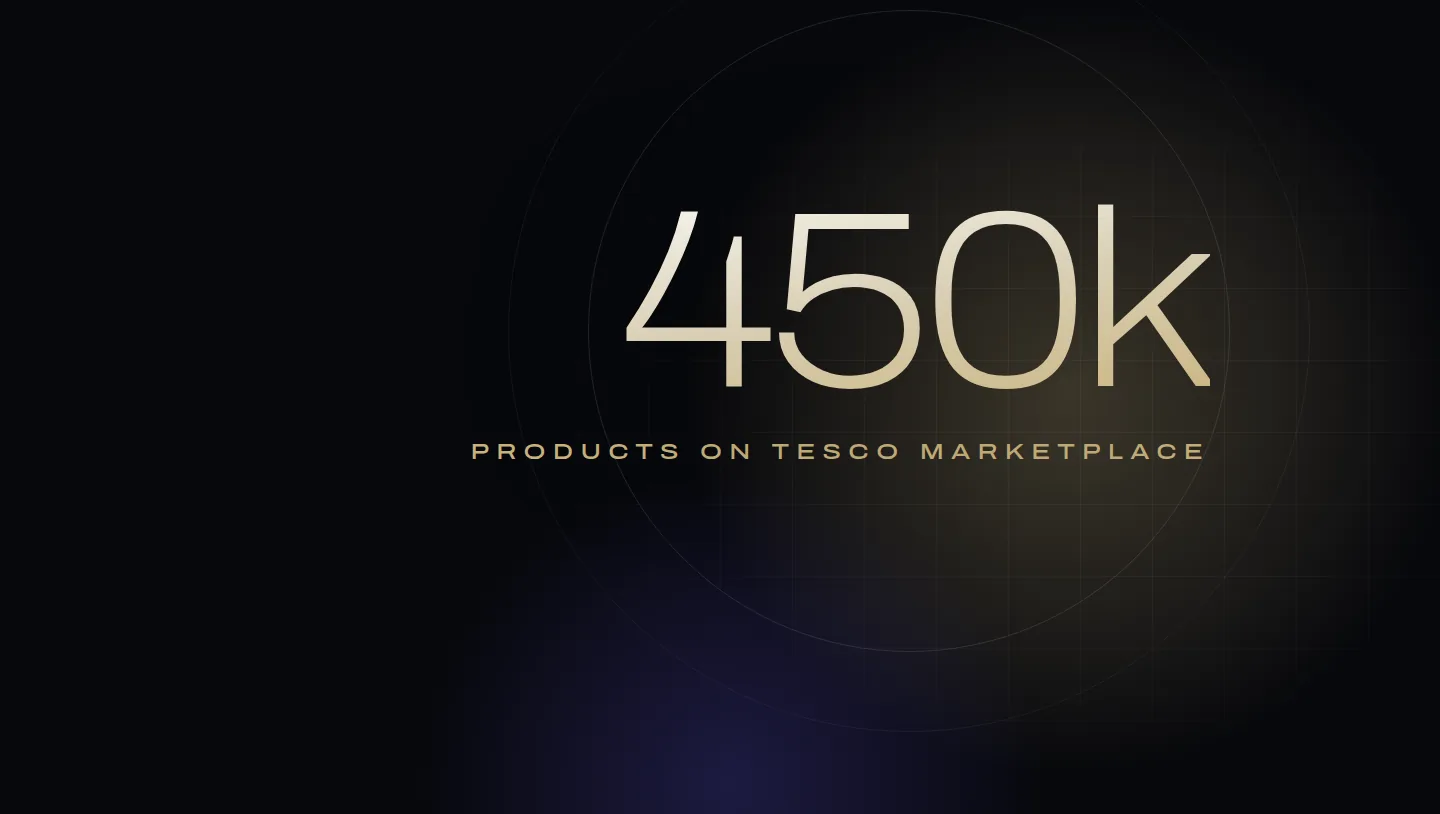
- c.450,000
- Third-party products on Tesco Marketplace, from more than 500 sellers (Tesco, April 2026)
- 1 point per £1
- Clubcard points customers collect on Marketplace products, the same as groceries
- 30 days
- Tesco's Marketplace change-of-mind return window
- 13.9%
- Tesco commission at which a £30 product matches its FBA margin on Amazon (illustration)
From Robert Prime and the Mr. Prime team, who run Amazon and marketplace accounts for founder-led UK brands.
Most of the people searching for Tesco Marketplace are shoppers wondering why a garden bench in their basket is coming from someone other than Tesco. This guide is for the other side: brands deciding whether to sell there. It belongs with our guides to selling on TikTok Shop in the UK and TikTok Shop fees, the other marketplace most UK brands weigh up next to Amazon. It covers what Tesco Marketplace is, how to get on it, what Tesco publishes about fees and fulfilment (and what it doesn’t), who it suits, and how to compare it with Amazon UK on the only measure that matters, the margin each order leaves you. If you are still choosing your first marketplace, start with our TikTok Shop vs Amazon guide; for running several channels together, see our multichannel guide.
What Tesco Marketplace is
Tesco Marketplace is the part of Tesco.com and the Tesco app where approved third-party sellers list products Tesco doesn’t stock itself. Customers add them to the same basket as their groceries, but the order splits: Marketplace items are delivered by the seller, by post or courier, separately from Tesco’s home delivery, Whoosh and Click+Collect6. Tesco takes the payment and puts returns requests through the customer’s Tesco account710. Customers with a Clubcard collect 1 point per £1 on Marketplace products, the same as on groceries8.
When it started. Tesco launched it in the first week of June 2024. On its Q1 analyst call on 14 June 2024, Tesco said “last week we launched Tesco Marketplace”, describing it as a way to offer “a broader range of thousands of products alongside the groceries”. It also explained the difference from the old Tesco Direct: Marketplace is fully integrated into Tesco’s grocery home-shopping platform, while delivery is fulfilled by a third party3.
How big it is now. In its 2025/26 results on 16 April 2026, Tesco said Marketplace offered “c.450k third-party SKUs from >500 sellers” and that over one million customers had tried it. It also said the platform was “re-platformed with Mirakl” in October 2025 “to improve seller onboarding process and enhance the customer proposition"24. Tesco reported UK online sales of over £7bn in the same results4, though that figure is mostly groceries, not Marketplace.
Why sellers are interested. Tesco’s own pitch is reach: “the UK’s largest grocery platform” and “tens of millions of Clubcard members who can earn points on your products"111. Tesco says it is looking for sellers who share its values on “quality, trust and reliable customer service"1. In other words, it is selective. It is not an open marketplace where anyone with a VAT number can list.
How sellers join
Tesco PLC’s suppliers page and the Tesco.com help centre both send sellers to a single application form111. There is no self-service sign-up. The form asks for5:
- Contacts: a primary contact and the person who will sign Tesco’s terms.
- Company details: trading name (shown to customers), legal entity name, your biggest category by sales, projected sales over the next 12 months (under £1m, £1m to £10m, or over £10m) and estimated SKU count.
- Platform management: your own website (Tesco asks you not to give an Amazon storefront), your integration method, whether you use a channel manager, and which other marketplaces you sell on (Amazon, eBay, B&Q, The Range, Wayfair, Argos or others).
- Channel classification: brand owner or manufacturer (with a list of brands owned), authorised distributor (with a letter of authorisation for each brand), distributor, or reseller.
- Compliance: confirmation that your company is registered in the UK with a UK company number and UK VAT number, can ship to all UK postcodes, can manage returns and has customer service in place. If not, Tesco says it can’t progress the application.
The platform and partner route
Tesco Marketplace runs on Mirakl since October 20254. The application form lists the integration routes Tesco accepts5:
| Route | Suits |
|---|---|
| Channel manager | Brands already using one for Amazon and eBay |
| Linnworks | Brands running orders and stock in Linnworks |
| M-Connect: Shopify | Shopify brands |
| M-Connect: Adobe/Magento | Magento brands |
| Mirakl Connect | Brands selling on other Mirakl marketplaces |
| Full API or hybrid API | Brands with their own development resource |
Channel-management companies such as ChannelEngine publish their own Tesco set-up guides, and send sellers to Tesco’s application form first12. A partner can connect your catalogue and stock; it can’t get you approved. The approval decision is Tesco’s.
GS1 UK, the barcode standards body, advises that Tesco may require valid GTINs for each product and variant, and that resellers must use the brand owner’s GTIN rather than create their own13. Check this for your category before you prepare the catalogue.
Getting from application to first order
- Check the basicsUK company number and VAT number, delivery to every UK postcode, a returns process and customer service. Without all four, Tesco won’t progress the application.
- Pick your lead category and rangeChoose the category where you are strongest and a focused range you can fulfil reliably.
- Choose the integration routeUse the channel manager or platform connector you already run; it makes stock sync with Amazon and your site far easier.
- Apply through Tesco’s formBe specific about projected sales, SKU count and whether you are the brand owner.
- Read the terms before buying stockThe commission, payment terms and service standards arrive with Tesco’s offer. Model your margin then, not before.
- Launch smallA few dozen products you can ship on time. Add range once delivery and returns run cleanly.
Categories
Tesco doesn’t publish a list of categories it is recruiting in, but its application form asks for your biggest category from this list5: Baby & Toddler; BWS (beer, wine and spirits); Clothing; Cook; Electrical Accessories; Food; Garden & Seasonal Events; Health & Beauty; Home Electricals; Home Lifestyle; Household; PC & Gaming; Pet; Sports & Leisure; Stationery & Office Supplies; Toys & Games; TV & Audio; and Trending.
Tesco’s launch commentary pointed at range that a supermarket can’t carry in store: specialised products in “food and food related missions”, stretching into clothing and home3. In our reading, the strongest fit is products a grocery shopper buys on the same trip or for the same household: home, garden, pet, baby, kitchen, health and beauty, and food specialities. Big, heavy and age-verified products may need specialist delivery6.
Fees: what Tesco publishes, and what it doesn’t
Tesco does not publish its seller fees. Neither the Tesco PLC sellers page, the Tesco.com help centre nor the application form states a commission rate, a monthly fee or a set-up fee1115.
Third parties describe the model. ChannelEngine, an integration partner, says Tesco “does not charge a setup fee or a monthly fixed fee” but charges a commission that “varies per product category”, and lists payment as monthly on the 1st and 15th12. GS1 UK also describes a commission by category, and advises sellers to confirm whether any set-up, listing or subscription charges apply under the current terms, and to remember that VAT may apply to marketplace fees13. These are not Tesco’s own statements, so treat them as a guide until you see Tesco’s terms.
The costs you can count on, whatever the commission:
- Fulfilment. You pick, pack and ship every order. There is no Tesco equivalent of FBA.
- Delivery charges are capped. For most products, customers pay up to £3 for standard delivery (3 to 5 working days) and up to £6 for express (1 to 2 working days) per seller. Big, heavy or age-verified items go by specialist delivery: up to £10 standard (5 to 7 working days) and £20 express. Tesco’s Delivery Saver doesn’t cover Marketplace9. Whatever your courier charges you above what the customer pays comes out of your margin.
- Returns. Tesco’s Marketplace return promise lets customers change their mind within 30 days for a replacement or refund, and says faulty items within 12 months get a refund, repair or replacement. Standard delivery charges are usually refunded if the item comes back within 14 days10. Budget for returns on that basis.
- Integration. A channel manager or connector subscription, if you don’t already have one.
How it compares with Amazon UK, on margin
The fair comparison is margin per order, after every cost, for the same product. Here is one, with Amazon’s fees as published and everything else illustrative.
A home product sells for £30 including VAT, which is £25.00 without it at the 20% standard rate16.
| Per order | Amazon UK, FBA | Tesco Marketplace |
|---|---|---|
| Price without VAT | £25.00 | £25.00 |
| Referral fee or commission | £4.50 (15% of £30) | Not published |
| Fulfilment | £4.00 FBA fee (illustrative) | £4.50 own pick, pack and courier (illustrative) |
| Digital services fee | £0.17 (2% of Amazon’s fees) | None known |
| Cost of goods | £9.00 | £9.00 |
| Returns and storage allowance | £1.00 | £1.00 |
| Left before advertising and commission | £6.33 | £10.50 before commission |
Amazon’s referral fee for Home is 15% on items above £20, its digital services fee is 2% of selling and fulfilment fees for UK-established sellers14, and the referral fee is calculated on a fee base that includes taxes15. The Professional selling plan adds £25 a month14.
Tesco leaves £10.50 before its commission. The product earns the same on Tesco as through FBA when the commission is £4.17, which is 13.9% of the £30 price (assuming, as on Amazon, the commission is charged on the VAT-inclusive price).
Three things the table doesn’t show:
- Volume. Tesco Marketplace has about 450,000 products2. In our experience, for most brands Amazon UK sells many times more units of the same product, because far more shoppers start their search there. A higher margin on a small number of orders can be worth less than a thinner margin on many.
- Advertising. On Amazon, most brands pay for visibility with Sponsored Products; our break-even ACoS guide shows how to keep that profitable. We found no self-serve advertising option for Marketplace sellers on Tesco’s published seller pages, so ask what visibility options come with your terms.
- Operations. Selling through FBA means Amazon ships and handles customer service. On Tesco you do both, to Tesco’s standards, for every order. If you already ship from your own warehouse or a third-party logistics provider, that is a small change. If you only use FBA, it is a new operation. Our FBA fees guide and Seller Fulfilled Prime guide cover the trade-off on the Amazon side.
Who Tesco Marketplace suits
From what Tesco asks for and how the marketplace works, it suits:
- UK brand owners and authorised distributors with a UK company and VAT registration. Tesco asks resellers to say so, and distributors to provide letters of authorisation5.
- Brands that already ship their own orders, from their own warehouse or a fulfilment partner, and can deliver anywhere in the UK within Tesco’s standard and express windows.
- Products that belong in a household shop: home, garden, pet, baby, kitchen, health and beauty, and specialist food and drink.
- Brands with margin to spare after their own fulfilment cost, so that a category commission still leaves a profit.
- Brands with a channel manager or a Shopify, Magento or Linnworks set-up, which keeps stock in sync with Amazon and your own site.
It suits less well:
- FBA-only brands with no way to ship orders themselves.
- Products that rely on search discovery, where Amazon’s demand does the work.
- Low-price, heavy or bulky items, where your delivery cost is high against the £3 or £10 the customer pays.
- Resellers of other brands’ products without authorisation.
The way we approach it for the brands we work with: get Amazon profitable first, then treat Tesco as an incremental channel with a small, well-chosen range, judged on contribution per order after fulfilment and returns. If it sells, extend the range. If it doesn’t, the cost of trying was mostly the integration.
Frequently asked questions
What is Tesco Marketplace?
Who delivers Tesco Marketplace orders?
How do I become a seller on Tesco Marketplace?
How much does it cost to sell on Tesco Marketplace?
Is Tesco Marketplace better than Amazon for sellers?
Do customers get Clubcard points on Tesco Marketplace?
Sources
- Suppliers & Sellers: sell on Tesco Marketplace. Tesco PLC. Checked 1 October 2026.
- Preliminary Results 2025/26 (results presentation). Tesco PLC, 16 April 2026. Checked 1 October 2026.
- Q1 analyst call transcript. Tesco PLC, 14 June 2024. Checked 1 October 2026.
- Preliminary Results 2025/26. Tesco PLC, 16 April 2026. Checked 1 October 2026.
- Apply to sell on Tesco Marketplace. Tesco Marketplace. Checked 1 October 2026.
- How Marketplace delivery works. Tesco.com help, updated 18 June 2025. Checked 1 October 2026.
- Why Tesco takes payment for Marketplace orders. Tesco.com help. Checked 1 October 2026.
- Collecting Clubcard points on Marketplace. Tesco.com help. Checked 1 October 2026.
- Delivery options and charges (Marketplace). Tesco.com help, updated 24 June 2025. Checked 1 October 2026.
- Our Marketplace return promise. Tesco.com help, updated 11 June 2026. Checked 1 October 2026.
- Becoming a seller on Tesco Marketplace. Tesco.com help, updated 17 September 2026. Checked 1 October 2026.
- Tesco: marketplace guide (third-party integrator). ChannelEngine. Checked 1 October 2026.
- Selling through Tesco Marketplace with trusted product data. GS1 UK. Checked 1 October 2026.
- Selling on Amazon fee schedule (referral fees, selling plans, digital services fee). Amazon Seller Central UK. Checked 1 October 2026.
- Referral fee calculation methodology (fee base amount). Amazon Seller Central UK. Checked 1 October 2026.
- VAT rates. GOV.UK. Checked 1 October 2026.
How this guide was made
Written by Robert Prime and reviewed by Atouka Tsochataridis at Mr. Prime, which runs Amazon and marketplace accounts for UK brands. We used AI tools to help research and draft it; Robert edited it and takes responsibility for it. Every Tesco and Amazon fact was checked against the Tesco PLC, Tesco.com, Tesco Marketplace or Seller Central UK page listed above on 1 October 2026. Tesco does not publish its seller commission, so we don’t quote one; where a figure comes from a third party, we say so. The worked example uses invented figures.
Every figure above links to the primary source it came from, and we recheck them when Amazon changes its fees or definitions. Read our editorial standards. Spotted something wrong? Tell us through our contact page and we will correct it and note the change here.
About the author
Robert Prime
Robert has spent more than two decades building, growing and selling online businesses, including an Amazon brand he built and sold for seven figures.
His other exits include Telematics.com, sold to LexisNexis, and Remortgage.com. He co-owned UpDownDesk.com.au, growing it on Shopify alone from £12k to £350k a month before he exited, one of more than six Shopify businesses he has built and sold.
He sets and reviews the strategy for every Mr. Prime client, with the view of an operator who has sat on your side of the table.

Reviewed by
Atouka Tsochataridis
A former soldier who overdelivers every time. Runs growth across the client book and is on WhatsApp with clients at all hours.
Your numbers, not ours
See your own break-even, TACoS and profit after ads.
The Profit X-Ray works it out from four monthly figures, or from your Business Report, in your browser.