
FBA & operations · 11 minute read
FBA vs FBM: which is more profitable, SKU by SKU?
Fulfilment by Amazon or fulfilment by merchant is not a choice you make once for a whole business. It is a sum you do for each product. Here is the sum, four worked examples, and the hybrid most UK brands end up running.

By Robert Prime, CEO and co-founder
Reviewed by Atouka Tsochataridis, Growth Director
- Published
- Last reviewed
- Sources
- 15 primary and labelled
Cover designed for Mr. Prime.
The short answer
Key takeaways
- Yes, you can sell on Amazon without FBA. With FBM you store, ship and handle customer service and returns yourself, and Amazon holds you to cancellation, tracking and late-dispatch metrics.
- FBA offers qualify for Prime; plain FBM offers do not. The only way to keep the badge while shipping yourself is Seller Fulfilled Prime.
- Compare per unit: FBA’s fulfilment fee with surcharges, storage for the cover you hold and inbound freight, against your label, packaging, labour, space, customer service and returns.
- In our four examples FBA is cheaper for three products and FBM for one, the bulky slow seller. A box 1 cm over a carrier’s band can flip the answer.
- Most brands run a hybrid: FBA for fast movers, Seller Fulfilled Prime or FBM for bulky and slow lines, and Multi-Channel Fulfilment only where its fees beat their own warehouse.
By the numbers
- 2.5%
- Highest cancellation rate Amazon UK expects on seller-fulfilled orders, measured over 7 days
- 95%
- Valid tracking rate an FBM seller must keep over 30 days, or offers may be deactivated
- £4.57
- UK Multi-Channel Fulfilment fee for a one-unit small parcel up to 400 g, against £3.00 for the same unit sold on Amazon via FBA
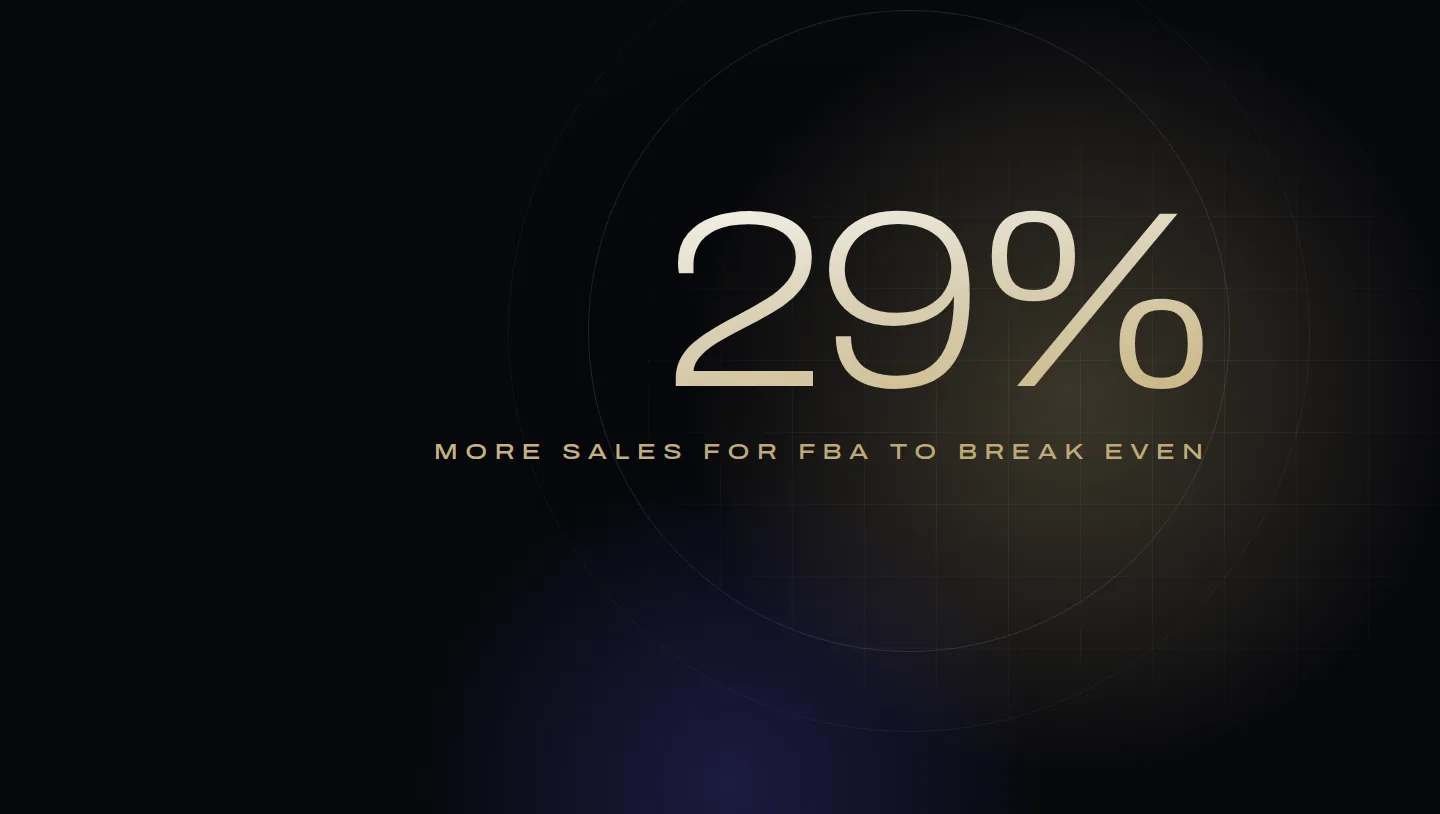
- 29%
- Extra sales FBA would have to bring the bulky example product to match FBM's profit (illustration)
From Robert Prime and the Mr. Prime team, who split founder-led UK brands’ catalogues between FBA, Seller Fulfilled Prime and their own warehouses, product by product.
“Should we use FBA or ship it ourselves?” is one of the first questions a brand asks about Amazon, and it is usually asked about the whole business. That is the wrong unit. FBA’s fees are set by each product’s size, weight and how long it sits in a warehouse, and your own costs vary the same way, so the right answer often differs between two products in the same range. This guide gives you the per-unit sum, runs it on four example products and turns the results into a decision table. For how FBA works, read what Amazon FBA is and when it pays; for every fee tier, our Amazon FBA fees UK guide.
FBA vs FBM at a glance
FBA means Amazon stores your stock and picks, packs and delivers each order; your products qualify for Prime and free delivery, and Amazon provides customer service and handles returns1. FBM, fulfilment by merchant, means you or your 3PL do all of that. Seller Fulfilled Prime sits between them: you ship, but keep the Prime badge, if you meet Amazon’s standards11.
What matters for profit is which cost lines change:
| Cost line per unit | FBA | FBM |
|---|---|---|
| Referral fee | Same either way6 | Same either way |
| Fulfilment | Amazon’s fee by size tier, plus a 1.5% surcharge and the 2% digital services fee256 | Your carrier label |
| Storage | Per cubic foot per month, roughly double from October to December4 | Your warehouse cost |
| Getting stock in | Freight and prep into Amazon | None beyond your normal inbound |
| Packaging and labour | Included in Amazon’s fee | Yours |
| Customer service and returns | Amazon’s, with returns fees in some cases | Yours |
| Prime badge | Yes, while eligible stock is at Amazon1 | No, unless you join Seller Fulfilled Prime |
The referral fee drops out of the comparison because you pay it either way. Leave it out, and you are left with a clean like-for-like.
Can you sell through Amazon without FBA?
Yes. Plenty of established sellers fulfil some or all of their Amazon orders themselves, and nothing in Amazon’s rules requires FBA. What you take on is the operation, and a set of metrics Amazon uses to judge it:
- Cancellation rate under 2.5%, measured over seven days, on seller-fulfilled orders7.
- Valid tracking rate of 95% over 30 days; seller-fulfilled offers below it may be deactivated8.
- Late shipment rate, measured over 10 and 30 days; a high rate puts seller-fulfilled offers at risk of deactivation9.
Buy Shipping, Amazon’s label-buying service, takes some of the sting out. If you buy labels through it and dispatch on time, you are protected from A-to-z claims about delivery problems affecting your Order Defect Rate, although you still carry the financial loss, and feedback that only concerns late or missing parcels can be struck through10.
You also own customer service and returns, which FBA would otherwise handle1. For a brand with a warehouse and a customer service team already serving its website, that is often a small step. For a brand that relies on a 3PL, it means checking that the 3PL can meet same-day dispatch and Amazon’s tracking rules before switching anything.
Prime eligibility: the difference that moves conversion
The cost comparison is only half the decision. Amazon says products sold through FBA qualify for Prime and free delivery1; plain FBM offers do not carry the badge. That matters most where shoppers filter for Prime and where the competing offers on the first page already show it.
You can have the badge without FBA through Seller Fulfilled Prime, but the bar is high. In the UK it requires a Professional account, a 99% on-time shipment rate, cancellations of 0.5% or less, Buy Shipping on at least 98% of Prime orders, approved carriers and dispatch on a weekend day as well as weekdays12. Our Seller Fulfilled Prime guide covers the trial, the carriers and the costs.
So there are really three options to compare for each product: FBA, Seller Fulfilled Prime and plain FBM.
The per-unit formula
Work out both sides for one unit sold, using your real cover (how long a unit sits before it sells) rather than Amazon’s minimums.
FBA cost per unit
(Fulfilment fee × 1.015 × 1.02) + storage per month × months of cover + freight and prep into Amazon
Use the fee for the product’s size tier and shipping weight; parcels and oversize are charged on the greater of unit weight and dimensional weight (length × width × height in cm ÷ 5,000).
FBM cost per unit
Carrier label + packaging + pick-and-pack labour + warehouse and software + customer service and returns
Count labour at what it really costs you, and give warehouse space a share per unit, even if you already pay for the building.
The 1.015 is the 1.5% fuel and logistics surcharge on UK FBA fulfilment fees since 17 April 20265. The 1.02 is the 2% digital services fee, which Amazon applies to FBA fees as well as selling fees on UK sales6. The difference between the two lines is what FBA saves or costs you on every unit, before Prime does anything for sales.
Four products, worked through
Here is the sum for four products from a hypothetical homeware brand that ships about 60 parcels a day across its channels, so it qualifies for Amazon Shipping’s 50-to-99-parcel band. For FBM it uses two-day services. Amazon’s fees, storage rates and the carrier rates are published figures; packaging, labour, space, customer service and freight are illustrative, so replace them with your own.
| Per unit sold (illustration) | Phone case, £12.99 | Ceramic planter set, £29.99 | Storage ottoman, £79.99 | Bathroom cabinet, flat-packed, £59.99 |
|---|---|---|---|---|
| Packed size and weight | 18 × 10 × 2 cm, 60 g | 30 × 22 × 20 cm, 1.3 kg | 60 × 40 × 40 cm, 6 kg | 62 × 35 × 15 cm, 8 kg |
| FBA size tier, weight charged | Low-price light envelope, 60 g | Standard parcel, 2.64 kg dimensional | Standard oversize light, 19.2 kg dimensional | Standard oversize light, 8 kg |
| FBA fee with surcharge and DSF | £1.57 | £3.61 | £7.46 | £5.74 |
| Storage | £0.01 (1 month) | £0.53 (1.5 months) | £3.73 (2 months) | £1.26 (2 months) |
| Freight and prep into Amazon | £0.05 | £0.40 | £2.00 | £1.20 |
| Total via FBA | £1.63 | £4.54 | £13.19 | £8.20 |
| Amazon Shipping two-day label with 2.5% fuel | £2.67 (large letter) | £4.14 (standard parcel) | £4.97 (medium parcel) | £8.82 (large parcel) |
| Packaging, labour, space, customer service and returns | £0.67 | £1.99 | £4.36 | £3.05 |
| Total via FBM | £3.34 | £6.13 | £9.33 | £11.87 |
| FBA cheaper by | £1.71 | £1.59 | −£3.86 | £3.67 |
The FBA fees are from Amazon’s 2026 UK tables: £1.52 for a low-price light envelope up to 60 g3; £3.49 for a standard parcel up to 2.9 kg; and £4.35 plus £0.15 for each kilogram above 760 g for standard oversize light2, where we count each started kilogram. The phone case gets low-price FBA rates because it is priced below £20 and weighs under 400 g3. Storage is £0.76 per cubic foot a month for standard-size and £0.55 for oversize from January to September4. The labels are from Amazon Shipping’s published UK rate card15.
Three lessons come out of the table:
- Small and standard parcels favour FBA, often by more than people expect. Amazon’s fee covers the label, the packing and the customer service for less than most brands pay for the label alone.
- Bulky, slow products favour FBM. The ottoman pays for 19 kg it does not weigh, and for two months of space. FBM saves £3.86 a unit, and from October, when oversize storage rises to £0.87 per cubic foot4, the gap widens.
- Carrier bands matter as much as Amazon’s. The bathroom cabinet is 62 cm long, 1 cm over the carrier’s medium-parcel limit of 61 cm, so it pays the large-parcel rate15. Repackaged at 60 cm, its FBM cost would fall to about £8.02, roughly level with FBA. Check both rate cards before you decide, and before you design the box.
Then ask what Prime is worth
Where FBM is cheaper, you still have to ask whether losing the badge costs more in sales. Say the ottoman leaves £26.42 a unit after VAT, referral fee, cost of goods and advertising, before fulfilment (illustrative). Through FBA it makes £13.23 a unit; through FBM, £17.09.
Sales uplift FBA needs to match FBM
(FBA cost per unit − FBM cost per unit) ÷ (contribution before fulfilment − FBA cost per unit)
The same test as in our guide to what FBA is. If the answer is negative, FBA is already cheaper and wins without any uplift.
For the ottoman that is £3.86 ÷ £13.23 = 29%. If the Prime badge lifts its sales by more than 29%, FBA makes more money despite the higher cost per unit; if not, FBM does. Amazon does not publish a conversion uplift you can rely on for a single product, so the honest way to find out is a test: one product, one change, four to six weeks, the same advertising. Or take the third route: Seller Fulfilled Prime keeps the badge at a cost close to FBM’s, and on the same assumptions it makes £16.17 a unit.
The decision table
This is how we start the conversation with a brand. It is our practice, not an Amazon rule, and every row is a default to test with the sum above, not a verdict.
| Product profile | Start with | Why |
|---|---|---|
| Small, light, steady seller | FBA | The fee undercuts most labels; storage is pennies; Prime helps conversion |
| Priced at or below £20 and under 400 g | FBA | Low-price FBA rates apply automatically3 |
| Standard parcel, sells daily | FBA | Usually cheaper per unit and no operational risk |
| Bulky, light for its size | Seller Fulfilled Prime, or FBM | Dimensional weight and storage per cubic foot inflate FBA’s cost |
| Slow seller with months of cover | FBM, or FBA with small, frequent shipments | Monthly storage, then the aged inventory surcharge on old stock |
| Seasonal or unpredictable demand | Hybrid: FBA in season, FBM as backup | Avoids paying peak storage for stock that may not sell |
| Clothing and footwear with high returns | Test both | FBA’s returns processing fees and the return rate change the sum |
| Just over a carrier’s size band | Redesign the pack first | A centimetre can change the label by £3 to £4 |
| Personalised, made to order or fragile | FBM | Stock cannot sit at Amazon, or needs your handling |
| Hazardous goods or lithium batteries | Check both carefully | Extra FBA charges apply, and some carriers will not take them |
The aged inventory surcharge, returns processing fee and dangerous goods charges are set out in our FBA fees guide.
The hybrid approach
Very few of the brands we work with run a single model. The pattern we see most often has three parts:
- FBA for the core range: the small and standard-size products that sell every day. They earn Prime, and Amazon carries the operational risk.
- Seller Fulfilled Prime or FBM for the bulky and slow lines, shipped from the brand’s own warehouse or 3PL, which usually already serves its website and trade customers.
- A merchant-fulfilled fallback for FBA lines. When an FBA product is about to run out, switching the offer back to merchant fulfilment from the brand’s own stock keeps it selling while replenishment is in transit. This is our practice; plan it before you need it.
The hybrid also protects you from capacity limits, which cap how much stock you can send to FBA; our inventory management playbook covers how to plan within them. And it gives you something to compare. A brand that only uses FBA rarely knows what its own fulfilment would cost, and so never knows whether FBA is a bargain or a habit.
Amazon Multi-Channel Fulfilment
Multi-Channel Fulfilment (MCF) runs the other way: it uses your FBA stock to fulfil orders from outside Amazon, including your own website, through integrations such as Shopify and WooCommerce. No referral fee is charged on MCF orders. Sortable items up to 45.72 × 35.56 × 20.32 cm and 9 kg can ship in packaging without Amazon branding, and there are two speeds, Standard (48 hours) and Expedited (next day)13.
It is not priced like FBA. UK MCF fees rose by an average of 3.5% per unit on 29 May 2026, for single-unit orders on envelopes and parcels and for all oversize orders, and a 1.5% fuel and logistics surcharge has applied since 2 May 202614. The fee per item falls as the order gets bigger:
| Size tier | MCF Standard, 1 unit | MCF Standard, 2 units (per item) | MCF Standard, 3+ units (per item) | FBA, same unit sold on Amazon |
|---|---|---|---|---|
| Small parcel, up to 400 g | £4.57 | £3.41 | £2.52 | £3.00 |
| Standard parcel, up to 900 g | £5.61 | £4.26 | £3.40 | £3.06 |
| Small oversize, up to 760 g | £10.75 | n/a | n/a | £3.49 |
MCF rates are from Amazon’s 2026 UK MCF table14 and FBA rates from its 2026 UK fee table2, both before the 1.5% surcharge.
So MCF makes sense when your website orders are small and multi-unit, when you do not have a warehouse of your own, or when holding one pool of stock saves more than the fee premium. For single-unit orders it often costs more than shipping the parcel yourself. Whether TikTok Shop orders can go through MCF depends on TikTok’s own UK fulfilment rules, which our guide to running Amazon, TikTok Shop and your own site together covers.
Run the comparison on your own catalogue
- Export your catalogue with dimensions, weights, prices and monthly sales for each product.
- Work out FBA’s cost per unit for each with the FBA calculator, using the cover you actually hold.
- Cost your own fulfilment for the same products with your real carrier rates, packaging and labour.
- Rank by the difference. Products where FBA is cheaper stay in FBA. For the rest, work out the uplift FBA would need, and test the closest calls.
- Repeat every quarter, and every October, when FBA storage roughly doubles for standard-size stock4.
The decision is worth getting right because it compounds: fulfilment is often the second-largest Amazon cost after the referral fee, and it changes your break-even ACoS, and so how hard you can advertise each product. Our seller fees guide puts it alongside everything else Amazon charges, and the Profit X-Ray shows profit after advertising for your whole account.
Frequently asked questions
Can you sell through Amazon without FBA?
Is FBA or FBM more profitable?
Do FBM products get the Prime badge?
What is Amazon Multi-Channel Fulfilment and what does it cost?
Can I use FBA for some products and FBM for others?
Sources
- Get started with Fulfilment by Amazon (FBA). Amazon Seller Central UK. Checked 1 October 2026.
- 2026 Festive season peak fulfilment fee (with 2026 non-peak rates). Amazon Seller Central UK. Checked 1 October 2026.
- Low-price Fulfilment by Amazon fees. Amazon Seller Central UK. Checked 1 October 2026.
- Monthly storage fees. Amazon Seller Central UK. Checked 1 October 2026.
- FBA fulfilment fees (fuel and logistics surcharge). Amazon Seller Central UK. Checked 1 October 2026.
- Selling on Amazon fee schedule: Amazon UK. Amazon Seller Central UK. Checked 1 October 2026.
- Cancellation rate. Amazon Seller Central UK. Checked 1 October 2026.
- Valid Tracking Rate (VTR). Amazon Seller Central UK. Checked 1 October 2026.
- Late shipment rate. Amazon Seller Central UK. Checked 1 October 2026.
- Use Buy Shipping services. Amazon Seller Central UK. Checked 1 October 2026.
- Seller Fulfilled Prime: features, requirements and FAQ. Amazon (sell.amazon.co.uk). Checked 1 October 2026.
- Maintain enrolment in Seller Fulfilled Prime. Amazon Seller Central UK. Checked 1 October 2026.
- Multi-Channel Fulfilment: fulfil orders for your sales channels. Amazon Seller Central UK. Checked 1 October 2026.
- UK Multi-Channel Fulfilment 2026 fee updates. Amazon Seller Central UK. Checked 1 October 2026.
- Amazon Shipping: Next-Day and Two-Day Delivery Rate Card (PDF). Amazon Shipping UK. Checked 1 October 2026.
How this guide was made
Written by Robert Prime and reviewed by Atouka Tsochataridis, who decide fulfilment routes for founder-led brands at Mr. Prime. We used AI tools to help research and draft it; Robert edited it and takes responsibility for it. Every fee, metric and date was checked against the Seller Central UK, sell.amazon.co.uk or Amazon Shipping page listed above on 1 October 2026. The example products and our own operating costs are illustrations, and where we give our own practice or opinion, we say so.
Every figure above links to the primary source it came from, and we recheck them when Amazon changes its fees or definitions. Read our editorial standards. Spotted something wrong? Tell us through our contact page and we will correct it and note the change here.
About the author
Robert Prime
Robert has spent more than two decades building, growing and selling online businesses, including an Amazon brand he built and sold for seven figures.
His other exits include Telematics.com, sold to LexisNexis, and Remortgage.com. He co-owned UpDownDesk.com.au, growing it on Shopify alone from £12k to £350k a month before he exited, one of more than six Shopify businesses he has built and sold.
He sets and reviews the strategy for every Mr. Prime client, with the view of an operator who has sat on your side of the table.

Reviewed by
Atouka Tsochataridis
A former soldier who overdelivers every time. Runs growth across the client book and is on WhatsApp with clients at all hours.
Your numbers, not ours
See your own break-even, TACoS and profit after ads.
The Profit X-Ray works it out from four monthly figures, or from your Business Report, in your browser.