
Choosing an agency · 10 minute read
Amazon Strategic Account Services vs an agency: what each costs a UK brand, and what each won't do
Amazon changed the UK fees for its paid account management in 2026, and most pages about it still quote the old US price. Here are the UK fees from Amazon's own pages, what they come to at your size, the five things the fee table leaves out, and the honest comparison with an agency.

By Robert Prime, CEO and co-founder
Reviewed by Stephen Harrison, Account Director
- Published
- Last reviewed
- Sources
- 3 primary and labelled
Cover designed for Mr. Prime.
The short answer
Key takeaways
- SAS Pro has three UK tiers, set by your last 12 months of sales and reviewed each January and July: £360 + 0.6%, £675 + 0.4% and £1,440 + 0.3% of last month’s sales, plus VAT.
- At £1M a year the fee is about £860 a month; at £3M it is about £1,675. In an average month the £4,950 cap only makes a difference above roughly £14M a year.
- The percentage is charged on UK and EU sales together, on the previous month, so Q4 peaks land on your December and January invoices.
- Amazon’s terms say SAS will not be involved in setting prices, listing and delisting, product selection or “offer and promotional enhancement”. Ads support is guidance, so someone still has to do the work.
- There is a 6-month minimum. Cancel inside it and you still pay for the rest of the term.
By the numbers
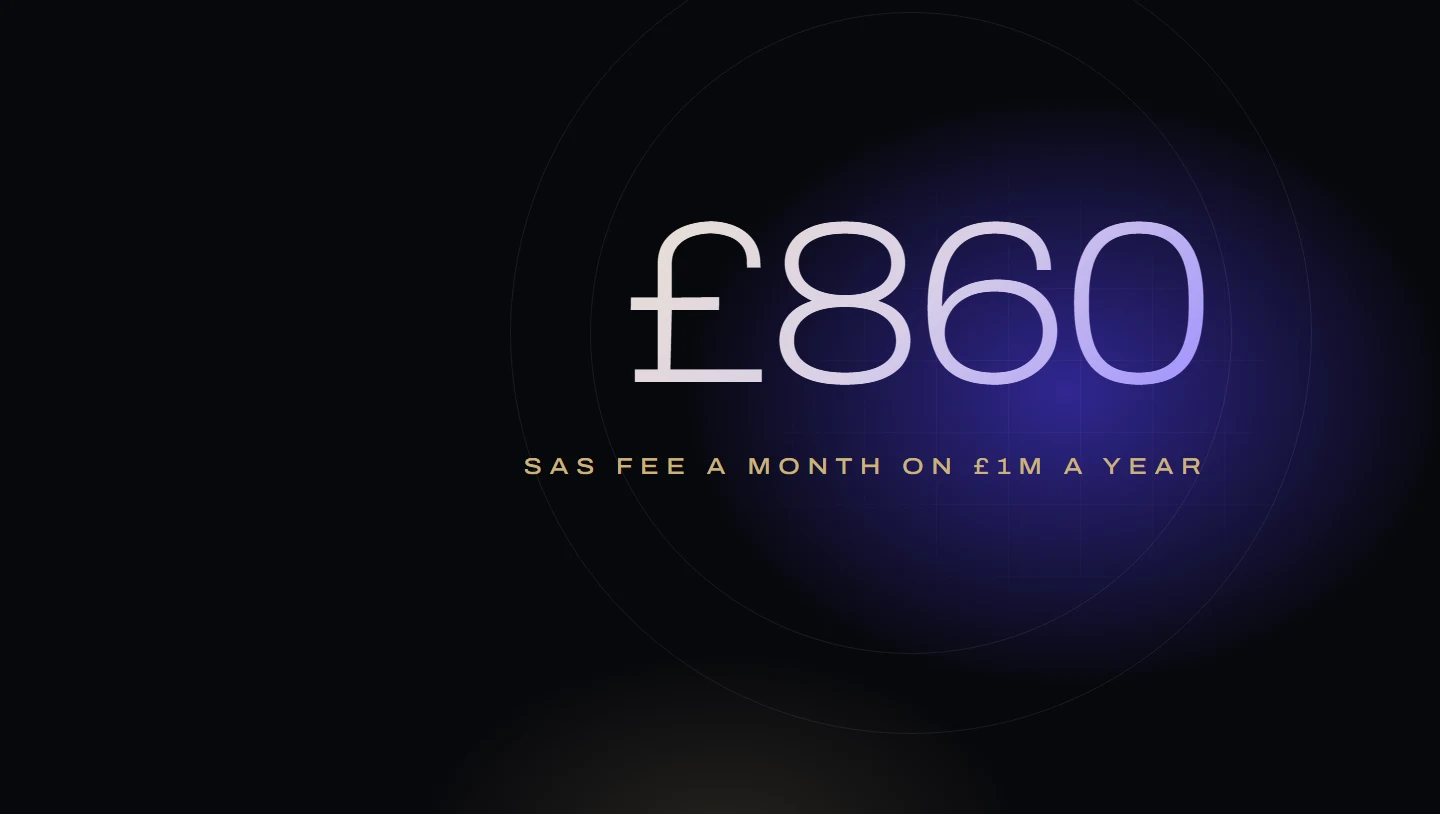
- £860
- SAS Pro fee a month for a brand selling £1M a year on Amazon UK (our sum from Amazon's table, before VAT)
- 6 months
- Minimum term, then 30 days' written notice to leave
- £14M
- Yearly sales before the £4,950 monthly cap changes an average month's bill (our sum)
- 6.9%
- Growth the SAS fee needs to pay for itself on £1M a year at a 15% margin on extra sales (worked example)
From Robert Prime and the Mr. Prime team, who manage Amazon advertising for founder-led UK and European brands: £2.5m of ad spend across our client accounts in the last 12 months. Several of the brands we speak to already pay for Amazon’s account management.
We are an Amazon agency, so you would expect us to tell you to skip Amazon’s own account management and hire us. We won’t. Several brands that come to us already pay for it, and for some of them it is good value. What it isn’t is the same thing as an agency, and most of what has been written about it is out of date for UK sellers. Amazon’s UK fees changed in 2026. Pages that still quote “$1,600 plus 0.3%” or a three-month minimum are describing the US scheme or the old one.
Everything below comes from Amazon’s own UK pages, read on 24 October 2026. Where we have done a sum from Amazon’s table, we say so.
What SAS Pro is
Strategic Account Services is Amazon’s paid account management. In the UK and EU it is now called SAS Pro. You get a Marketplace Consultant who, in Amazon’s words, “is an Amazon employee with access to internal tools, data, and expert teams"1. Amazon lists what that covers:
- Business reviews, every two months in the Base tier and monthly in Plus and Premium1.
- A response within 48 hours in Base and 24 hours in Plus1.
- Escalations. The consultant “acts as your internal advocate” when a listing is suppressed, your account is flagged or a case is stuck1.
- Execution support for “listing creation, content optimization, and catalog management"1.
- Guidance on ads, deals, FBA, expansion into other EU stores, Brand Registry and Amazon Business1.
It is not open to everyone. Amazon says enrolment “is subject to an eligibility review”, and your tier is set when you are approved1.
What it costs in 2026
Your tier depends on your sales over the last 12 months, and Amazon reviews it every January and July. The percentage is then charged on the previous month’s sales12.
| Tier | Monthly fee (before VAT) | Your last 12 months’ sales | Consultant |
|---|---|---|---|
| Base | £360 + 0.60% of last month’s sales | Under £1.8M | Shared across a larger group of sellers |
| Plus | £675 + 0.40% | £1.8M to £9M | Dedicated, with a smaller group |
| Premium | £1,440 + 0.30% | Over £9M | Works with a select few sellers |
All three tiers are capped at £4,950 a month, and VAT is added on top1. Amazon’s own examples: £100,000 of monthly sales on Base costs £960, £500,000 on Plus costs £2,675, and £1M a month on Premium costs £4,4401.
Here is what that comes to at the sizes we usually see. These are our sums from Amazon’s table, taking each year as twelve even months: £1M a year is £83,333 a month, so the fee is £360 + 0.6% × £83,333 = £860. Your real bill moves with your sales.
| Yearly Amazon sales | Fee a month | Fee a year | Tier |
|---|---|---|---|
| £500,000 | £610 | £7,320 | Base |
| £1,000,000 | £860 | £10,320 | Base |
| £1,500,000 | £1,110 | £13,320 | Base |
| £2,000,000 | £1,342 | £16,100 | Plus |
| £3,000,000 | £1,675 | £20,100 | Plus |
| £5,000,000 | £2,342 | £28,100 | Plus |
All fees are before VAT.
Five things the fee table doesn’t tell you
- It follows last month’s sales, so your peak lands later. The percentage is charged on sales “for the month preceding the month in which the invoice will be issued"1. A Base-tier brand selling £1.2M a year that does £250,000 in November pays £360 + £1,500 = £1,860 on its December invoice, nearly double the £960 of an average month. Budget for that before Black Friday, not after it.
- EU sales count too. The base is “products sold on the UK and EU Amazon Stores, including the item price and any delivery, gift-wrap or other charges"2. A month with £80,000 in the UK and £20,000 in Germany is charged on £100,000: £960, not the £840 the UK sales alone would cost.
- The minimum term is six months. After that you can leave with 30 days’ written notice. “If you cancel during the Minimum Term, you will be assessed the Programme Participation Fee” for the rest of it, and fees are non-refundable2. At £1M a year that commitment is about £5,160 before VAT. It cuts both ways: Amazon can end your enrolment “for convenience with 30 days’ advance notice”, and then no further fees are due2.
- One flat fee covers all your stores, if your account is unified. Amazon says the flat part is “charged once, regardless of how many EU/UK stores you sell on”; separate accounts per store are charged separately1.
- The £25 a month on the same page is not SAS. It sits next to the “New to Amazon? Sign up” button and is the Professional selling plan, which Amazon prices at “£25 (excl. VAT) per month"3.
What SAS does, and what Amazon’s terms say it won’t do
This is the part most comparisons skip. Amazon’s programme terms are plain about the limits:
“Amazon will not be involved in your responsibilities as a selling partner or your business strategy (such as setting prices, listing and delisting products, product selection, offer and promotional enhancement, account general settings and account activation or deactivation, staging).”
The same terms say joining “does not guarantee an increase in your sales"2, and the programme page says it “does not grant policy exceptions or preferential treatment"1.
| SAS Pro | Still yours to do (or an agency’s) | |
|---|---|---|
| Ads | “Guidance across Sponsored Products, Sponsored Brands, display advertising, and Amazon DSP"1 | Building campaigns, bids, budgets, negative keywords, weekly changes |
| Listings and catalogue | Execution support for listing creation, content and catalogue1 | Deciding what to list, delist and bundle |
| Pricing and promotions | Support for deals, coupons and Lightning Deals, and pricing tools1 | Setting prices, and “offer and promotional enhancement"2 |
| Account problems | An internal advocate for escalations1 | The fix itself, and the evidence |
| Profit | “Margin and profitability analysis” is listed among its growth levers1 | Owning the profit number |
So SAS is an informed adviser with a direct line into Amazon. Someone on your side still has to do the work.
SAS vs an agency, side by side
| SAS Pro | An agency | |
|---|---|---|
| Who they work for | Amazon. The consultant is an Amazon employee1 | You, under your contract |
| What you pay | A base fee + 0.3% to 0.6% of last month’s sales | Depends on the contract: a retainer, a share of ad spend or sales, or a hybrid |
| Runs your ads day to day | No, guidance only1 | Usually, if it is in the scope |
| Sets prices and promotions | No2 | Recommends them; you decide |
| Escalations inside Amazon | Yes, through internal teams1 | Usually the same Seller Support routes as you |
| Other channels | Amazon only | Can cover TikTok Shop and your own site, if it offers them |
| Minimum term | 6 months2 | Whatever you negotiate. Ask for a short notice period |
| Accountable for profit | Not in the terms | Only if you write it into the contract |
Neither column is better in every row. SAS has something no agency has, a direct line into Amazon’s teams. An agency has something SAS doesn’t offer, people who do the work and answer to you.
Compare the total cost, not the fee
The SAS fee looks small next to an agency’s, because it doesn’t pay for the doing. The fair comparison is:
What you are really comparing
SAS fee + your team’s time on Amazon, against an agency’s fee + the time your team still spends
Your team’s cost is the time of whoever turns the consultant’s advice into changes: campaigns, listings, prices, stock.
Then put each total through the same test we use for any Amazon cost: the growth it needs to pay for itself. Our agency pricing guide explains the sum.
If your team has the skills and the hours, SAS is the cheaper route by a long way. If it doesn’t, the cheap fee buys a well-informed plan that nobody carries out.
Amazon says sellers who joined SAS in 2024 “grew by 20% more than non-managed Selling Partners in Europe”, and notes that the figure is an average1. Read it as Amazon’s own figure, not a forecast. Our opinion is that sellers who apply and are accepted are already more active than average, which would lift that number whatever the consultant did.
What we see in practice
The pattern we see most often is not SAS against an agency. It is a brand with several helpers and nobody owning profit.
One seller who came to us had been on Amazon for many years, with about 100 products and roughly 85% of revenue from the top 10. They already had a paid Amazon account manager through SAS, an in-house designer and a separate PPC agency. Their open questions were all about money: margin, TACoS, holding the Featured Offer on their best-sellers, and sales leaking from the rest of the range. Each helper looked after its own piece. None of them was answerable for the profit number.
So when a brand already has SAS, our audit starts by asking what the consultant has already recommended. We don’t charge anyone, in time or money, for advice they already have.
Which route fits
- SAS on its own fits a brand with a capable in-house team that has time to act, whose main pain is escalations and catalogue problems, or that wants Amazon’s view on expanding into EU stores.
- An agency on its own fits a brand where nobody has the hours to run ads and listings properly, and that wants one party accountable for a profit target.
- Both fits a large catalogue with frequent escalations and an agency doing the work. Write down who owns what, so the consultant’s advice and the agency’s plan don’t contradict each other.
- Neither, yet fits a brand where the growth needed to cover either cost is out of reach. Fix the product economics first. Our break-even ACoS guide is the place to start.
Questions to ask before you sign either
For Amazon:
- Which tier will I be on, and when is it reviewed?
- Is my consultant shared with a large group of sellers? Amazon says Base means a “Shared MC across a larger seller portfolio"1.
- What happens in the first month? Amazon promises a welcome meeting and “a full performance evaluation of your account"1. Ask to see it.
- Who on my side will act on the advice, and how many hours a week will that take?
For an agency:
- Who will work on my account, and for how many hours?
- What will you own, and what stays with my team or with SAS?
- Will you judge the result on total sales and profit, or on ad-attributed sales?
- What is the notice period, and who owns the campaigns and data if we part?
Our UK agency guide has the full checklist for choosing an agency.
If you already pay for SAS and want to know where profit is still leaking, a Profit Audit is a second opinion. It sits alongside your consultant, not instead of them.
Frequently asked questions
How much does Amazon Strategic Account Services cost in the UK?
Is Amazon SAS worth it?
Does Amazon SAS manage my ads?
Can I cancel Amazon SAS?
Can I use SAS and an agency at the same time?
What is the £25 a month shown on Amazon's SAS page?
Sources
- Strategic Account Services: SAS Pro. Amazon (sell.amazon.co.uk). Checked 24 October 2026.
- Strategic Account Services Account Management Program Terms. Amazon Seller Central UK. Checked 24 October 2026.
- Selling on Amazon: pricing. Amazon (sell.amazon.co.uk). Checked 24 October 2026.
How this guide was made
Written by Robert Prime and reviewed by Stephen Harrison at Mr. Prime, which is itself an Amazon agency: read it with that in mind. We used AI tools to help research and draft it; Robert edited it and takes responsibility for it. Every SAS fee, term and quote was read on Amazon’s own UK pages on 24 October 2026. Every monthly fee at a given sales level is our own sum from Amazon’s table, and every worked example is labelled as one.
Every figure above links to the primary source it came from, and we recheck them when Amazon changes its fees or definitions. Read our editorial standards. Spotted something wrong? Tell us through our contact page and we will correct it and note the change here.
About the author
Robert Prime
Robert has spent more than two decades building, growing and selling online businesses, including an Amazon brand he built and sold for seven figures.
His other exits include Telematics.com, sold to LexisNexis, and Remortgage.com. He co-owned UpDownDesk.com.au, growing it on Shopify alone from £12k to £350k a month before he exited, one of more than six Shopify businesses he has built and sold.
He sets and reviews the strategy for every Mr. Prime client, with the view of an operator who has sat on your side of the table.

Reviewed by
Stephen Harrison
Fourteen years a police officer, then his own Amazon brands. Now runs more client accounts than anyone, meticulously.
Your numbers, not ours
See your own break-even, TACoS and profit after ads.
The Profit X-Ray works it out from four monthly figures, or from your Business Report, in your browser.