
Amazon strategy · 10 minute read
The Amazon flywheel: what it is, and what it means for a brand's profit
Amazon's flywheel is one of the best-known diagrams in business. It explains why Amazon keeps pushing prices down and selection up. For a brand selling on Amazon, the useful question is a different one: does your own flywheel make you more profit each time it turns?

By Robert Prime, CEO and co-founder
Reviewed by Atouka Tsochataridis, Growth Director
- Published
- Last reviewed
- Sources
- 9 primary and labelled
Cover designed for Mr. Prime.
The short answer
Key takeaways
- Amazon’s flywheel runs on customer experience: price, selection and convenience bring traffic, traffic brings sellers, and scale lowers the cost structure so the loop can turn again.
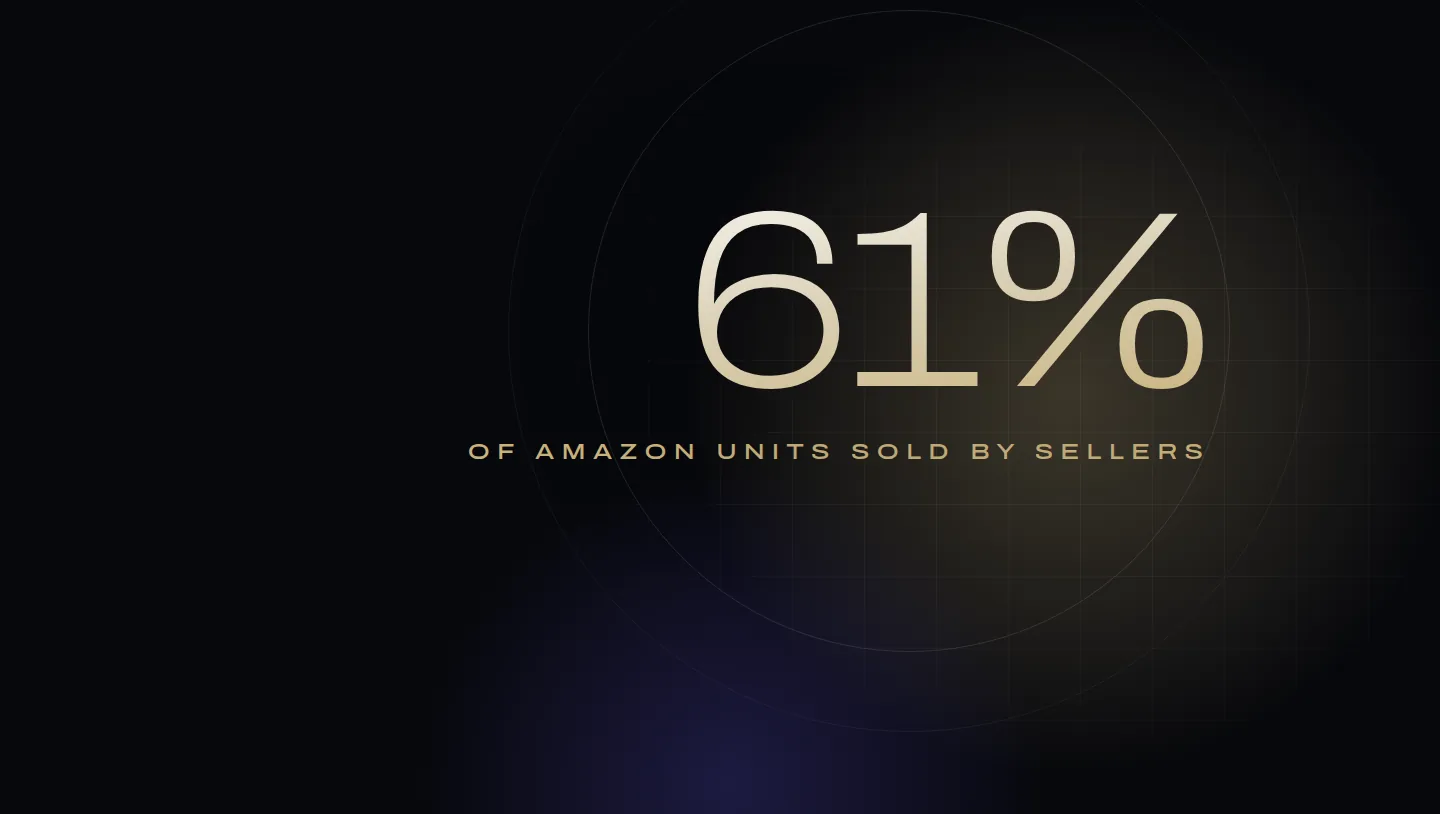
- Third-party sellers are a large part of it. They accounted for 61% of the units Amazon sold in the second quarter of 2026, and Amazon earned $46.8bn from seller services and $19.8bn from advertising in that quarter.
- Amazon’s flywheel is built to lower prices for shoppers. A brand inside it feels that as pressure on price, fees and advertising, so growth on Amazon does not automatically mean more profit.
- A brand’s own flywheel turns on conversion: a listing that converts earns sales, sales and reviews earn organic rank, and organic rank lowers the advertising cost of each sale.
- Check every turn with one formula: profit after advertising = sales × (margin before advertising − TACoS). If sales rise and that number falls, the flywheel is spinning backwards.
By the numbers
- 2001
- When Amazon's leaders took up the flywheel concept, according to Jim Collins
- 61%
- Share of Amazon's paid units sold by third-party sellers, Q2 2026
- $19.8bn
- Amazon advertising services revenue in Q2 2026, up 26% year on year
- +43%
- Profit change for the brand whose growth came from conversion, against −25% for the one that bought it (illustration)
From Robert Prime and the Mr. Prime team, who manage Amazon growth and advertising for founder-led UK brands and judge every plan on profit after advertising.
Few business diagrams are quoted as often as Amazon’s flywheel. Sellers hear it in conference talks, agencies put it in pitch decks, and it gets searched as often as “Amazon flying wheel” as by its right name. Most explanations stop at the circle of arrows. This guide covers where the idea came from, in Amazon’s own words where they exist, what it means for a brand that sells on Amazon, and the one test that tells you whether your own flywheel is making you money.
It is part of our guide to selling on Amazon in the UK. For how Amazon search turns sales into rank, read our Amazon SEO guide.
Where the Amazon flywheel came from
The flywheel is Jim Collins’s image before it is Amazon’s. In Good to Great he described how lasting results come from “relentlessly pushing a giant, heavy flywheel, turn upon turn, building momentum until a point of breakthrough"4. No single push makes the difference; each turn builds on the last.
Collins says Amazon took the idea up “coming out of the dot-com bust in 2001”, and then went further by naming the specific drivers of its own flywheel5. Brad Stone’s history of the company, The Everything Store, describes the loop Jeff Bezos and his team sketched, quoted here by Stratechery: “Lower prices led to more customer visits. More customers increased the volume of sales and attracted more commission-paying third-party sellers to the site. That allowed Amazon to get more out of fixed costs like the fulfillment centers and the servers needed to run the website. This greater efficiency then enabled it to lower prices further. Feed any part of this flywheel, they reasoned, and it should accelerate the loop.“6
That is the famous napkin drawing. Its parts are simple:
| Part of the loop | What it means |
|---|---|
| Customer experience | Low prices, wide selection and convenience |
| Traffic | Better experience brings more customer visits |
| Sellers and selection | More customers attract more third-party sellers, which widens selection |
| Growth | More sales across the same infrastructure |
| Lower cost structure | Fixed costs spread across more sales |
| Lower prices | Savings passed back to customers, which improves the experience again |
The flywheel in Amazon’s own words
Amazon’s leaders have returned to the idea in their letters to shareholders. In his 2014 letter, Jeff Bezos explained why Fulfilment by Amazon mattered so much: “FBA is so important because it is glue that inextricably links Marketplace and Prime.” When a seller joins FBA, he wrote, “their items can become Prime eligible”, which makes Prime membership more valuable, and “This is powerful for our flywheel.“1
Andy Jassy’s 2024 letter, published in April 2025, describes the decision that opened the store to other sellers in the same terms of customer choice: “Why not let customers choose the selection, price, and delivery speed they prefer from among these millions of sellers?“2
The numbers show how central sellers have become. In the second quarter of 2026, third-party sellers accounted for 61% of the units Amazon sold. Amazon earned $46.8bn from third-party seller services and $19.8bn from advertising in that quarter, with advertising up 26% on a year earlier3.
What the flywheel means for a brand
Read from a brand’s side, the flywheel has three consequences.
It brings you traffic. The loop works to send more shoppers to Amazon every year, and you can sell to them without building that audience yourself.
It pushes on your price. The loop exists to lower prices for customers. Every seller competing for the same shoppers is part of that pressure, and Amazon’s systems reward the offer that serves the customer best, as our Buy Box guide explains.
It charges for access. Selection grows, so standing out costs more. On top of the referral fee, 15% for most categories plus a 2% digital services fee on UK fees8, most brands now pay for visibility through advertising. Amazon’s advertising revenue growing faster than its seller services revenue3 is a sign of where sellers’ money is going.
None of that makes Amazon a bad place to sell. It means that growth on Amazon and profit on Amazon are different things, and the flywheel will happily deliver the first without the second.
Your own flywheel: the loop that matters to you
A brand on Amazon has a smaller flywheel inside Amazon’s. Ours, in practice, looks like this:
- A listing that converts turns traffic into sales.
- Sales and reviews raise conversion further: published research finds a product with five reviews is 270% more likely to be bought than one with none9.
- Sales history earns organic rank, because Amazon search rewards products that shoppers click and buy, as our Amazon SEO guide sets out.
- Organic rank lowers the advertising cost of each sale, because more sales arrive without a click you paid for.
- The margin released funds the next product, the next listing improvement or the next keyword.
Set side by side, the two loops share a shape but not a goal:
| Amazon’s flywheel | A brand’s flywheel on Amazon | |
|---|---|---|
| What it turns on | Customer experience: price, selection, convenience | Conversion: listing, offer, reviews |
| What brings traffic | Lower prices and wider selection | Organic rank earned by sales, plus advertising |
| What scale buys | Lower cost per order across fixed infrastructure | Lower advertising cost per sale as organic share grows |
| What it is designed to maximise | Amazon’s customer base and growth | Should be: profit after advertising for the brand |
| What can stall it | Slower delivery, weaker selection | Stock-outs, a falling rating, a price war, ads above break-even |
One turn, in numbers
Here is what a single turn looks like when it works, for the £24.99 product in our break-even ACoS guide, which keeps 26.5% of its £20.83 ex-VAT price before advertising.
Sales rose 15% and profit rose 28%, without spending another penny on ads. That is the flywheel working for the brand: the gain came from conversion and rank, not from buying more traffic. The rule of thumb we use is that a healthy turn shows sales up and TACoS down in the same month. Sales up with TACoS up means you are paying for the momentum, which is fine for a launch and a warning sign anywhere else.
Each step is a lever on profit, and each can be pushed the wrong way. Discounting buys sales that may not earn rank for long. Advertising above break-even buys sales history at a loss. Neither is wrong as a deliberate, time-limited choice. Both are wrong as a habit.
The test: does each turn add margin?
The formula from our break-even ACoS guide is the simplest way to check whether your flywheel is spinning forwards:
Profit after advertising
Total sales × (margin before advertising − TACoS)
TACoS is ad spend ÷ total sales; margin before advertising is what each £1 of sales keeps after cost of goods, Amazon’s fees and fulfilment. Use the ex-VAT basis on both sides: Amazon Ads reports sales without VAT.
Amazon Ads reports attributed sales without VAT7, so put total sales on the same basis before you compare.
Brand A grew sales by 50% and lost 25% of its profit. Brand B grew sales by 30% and made 43% more. On a sales dashboard Brand A is winning. On the bank statement Brand B is. Brand A’s flywheel is turning, but each turn takes margin out; it will need ever more advertising to hold its rank, and it has less money each month to pay for it.
Making your flywheel spin profitably
One turn of a profitable flywheel
- Know your margin before you pushWork out margin before advertising and break-even ACoS for each product. The Profit X-Ray does it for the account in a minute.
- Fix conversion firstMain image, title, item highlights, price and reviews. Traffic sent to a page that doesn’t convert speeds nothing up. Our listing optimisation guide covers the page.
- Buy traffic you can affordHold advertising at or below break-even ACoS, except in a launch or rank defence with a budget and an end date.
- Earn reviews within the rulesRequest a Review on every order, Vine for new products, and a product worth reviewing. See how to get reviews on Amazon.
- Let organic rank carry more of the salesWatch organic share and TACoS. Rank you have earned should let you lower bids on the terms you now rank for.
- Reinvest part of the margin, not all of itFund the next product or improvement from the profit released, and keep the rest. A flywheel that consumes all its own output is just a treadmill.
Check the flywheel monthly with three numbers: profit after advertising, TACoS and its direction, and organic share of sales. Our TACoS benchmarks guide shows what healthy looks like at different stages.
When the flywheel spins backwards
Momentum works in both directions. The patterns we see most often in accounts we are asked to review:
- Stock-outs. Sales stop, rank falls, and the restart needs advertising you didn’t budget for.
- A falling rating. Conversion drops, so every ad click costs more per sale, so advertising gets cut, so sales fall further.
- Price wars. Matching every competitor’s cut keeps the volume and drains the margin that paid for advertising.
- Advertising as the engine rather than the starter. If sales only hold while ad spend rises, the flywheel isn’t turning; you are pushing it every minute.
Where the metaphor misleads
The flywheel is a useful picture, but two parts of it are easy to take too literally.
A flywheel doesn’t spin for ever on its own. Collins’s point was that momentum builds from consistent effort, turn after turn, and that no single push creates the breakthrough4. On Amazon, competitors push too. A product that reached the top of its search results last year keeps its place only while it keeps converting better than the products around it. Treat rank as something you rent with conversion, not something you own.
Amazon’s flywheel and yours have different owners. Amazon’s loop is built to grow Amazon’s customer base by giving those customers lower prices, more selection and faster delivery, and its letters say so plainly12. Your interests overlap with that, because more shoppers are good for you, but they are not the same. When Amazon’s flywheel asks for a lower price or a faster delivery promise, the question for a brand is whether the extra sales earn back what the change costs. Sometimes they do: Prime eligibility through FBA is the example Bezos gave in 2014. Sometimes the answer is to hold the price and accept fewer, more profitable sales.
In each case the fix starts with the same question we ask of every turn: did this make the business more money, or just more sales?
Frequently asked questions
What is the Amazon flywheel?
Is it the Amazon flywheel or the Amazon flying wheel?
Who drew the Amazon flywheel?
How does the Amazon flywheel affect sellers?
How do I build a flywheel for my Amazon brand?
Sources
- 2014 Letter to Shareholders. Amazon.com, Inc. (Jeff Bezos). Checked 1 October 2026.
- CEO Andy Jassy's 2024 Letter to Shareholders. About Amazon, 10 April 2025. Checked 1 October 2026.
- Amazon.com announces second quarter results. Amazon Investor Relations, 30 July 2026. Checked 1 October 2026.
- The flywheel effect. Jim Collins. Checked 1 October 2026.
- Turning the Flywheel. Jim Collins. Checked 1 October 2026.
- The relentless Jeff Bezos (quoting Brad Stone, The Everything Store). Stratechery, 3 February 2021. Checked 1 October 2026.
- Attribution for sponsored ads. Amazon Ads help. Checked 1 October 2026.
- Selling on Amazon fee schedule (referral fees and digital services fee). Amazon Seller Central UK. Checked 1 October 2026.
- How online reviews influence sales. Medill Spiegel Research Center, Northwestern University. Checked 1 October 2026.
How this guide was made
Written by Robert Prime and reviewed by Atouka Tsochataridis, who set growth and advertising strategy for founder-led brands at Mr. Prime. We used AI tools to help research and draft it; Robert edited it and takes responsibility for it. Amazon’s statements and figures were checked against its shareholder letters, earnings release and help pages listed above on 1 October 2026. The account of the 2001 napkin sketch comes from Brad Stone’s book as quoted by Stratechery. The two-brand comparison is an illustration.
Every figure above links to the primary source it came from, and we recheck them when Amazon changes its fees or definitions. Read our editorial standards. Spotted something wrong? Tell us through our contact page and we will correct it and note the change here.
About the author
Robert Prime
Robert has spent more than two decades building, growing and selling online businesses, including an Amazon brand he built and sold for seven figures.
His other exits include Telematics.com, sold to LexisNexis, and Remortgage.com. He co-owned UpDownDesk.com.au, growing it on Shopify alone from £12k to £350k a month before he exited, one of more than six Shopify businesses he has built and sold.
He sets and reviews the strategy for every Mr. Prime client, with the view of an operator who has sat on your side of the table.

Reviewed by
Atouka Tsochataridis
A former soldier who overdelivers every time. Runs growth across the client book and is on WhatsApp with clients at all hours.
Your numbers, not ours
See your own break-even, TACoS and profit after ads.
The Profit X-Ray works it out from four monthly figures, or from your Business Report, in your browser.